Belladonna…or hierba mora?
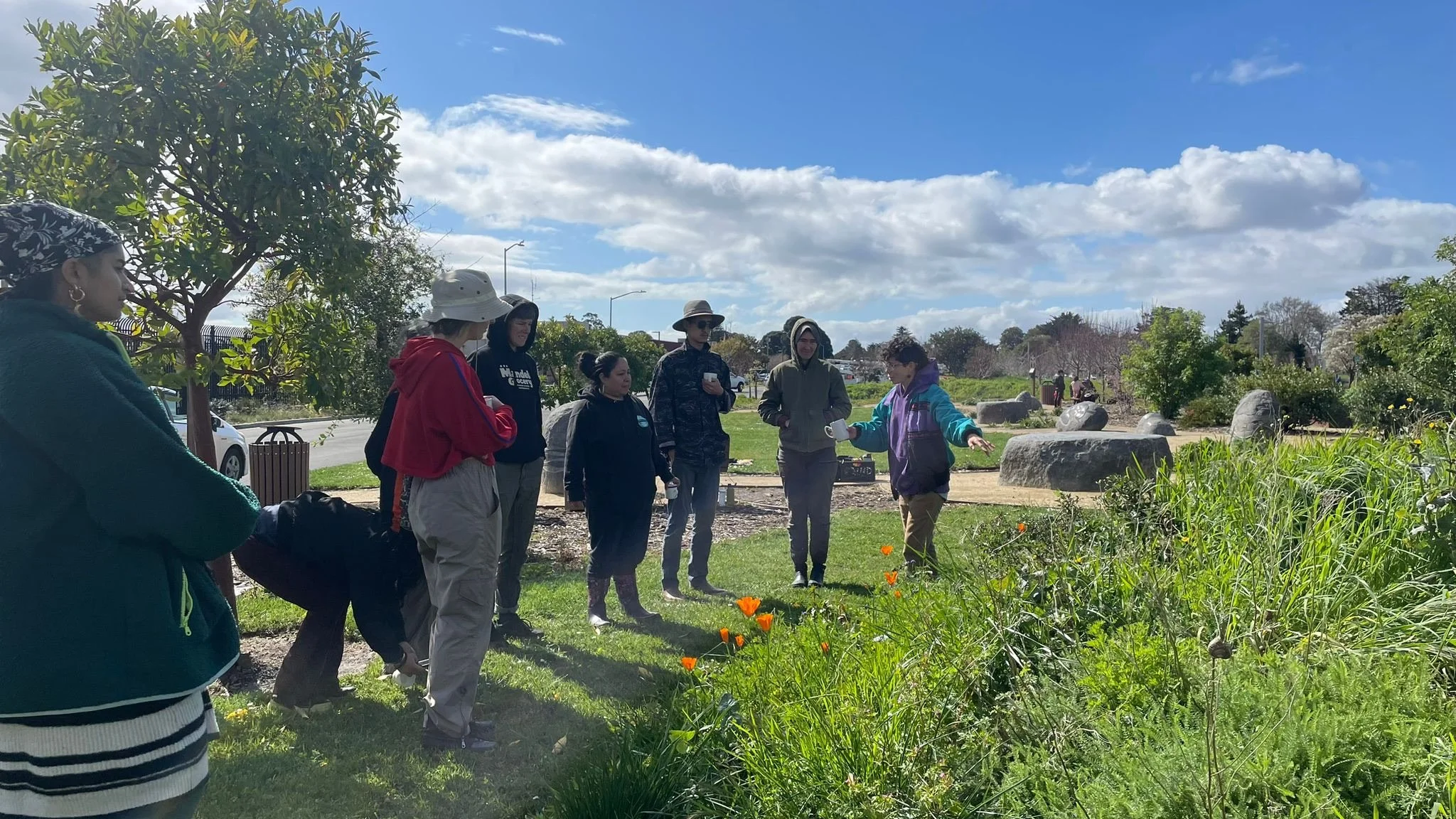
We met belladonna at ‘Ookwe Park, the first park returned to the care of the Confederated Villages of Lisjan and Sogorea Te’ Land Trust through a collaboration with the City of Richmond and the Richmond Arts and Culture Commission. One of the underlying intentions of our experimental series Transforming “Invasives”/ Welcoming Newcomers (TIWN) has been to cultivate space for those of us who come from diasporic lineages to see ourselves reflected in the landscape, and to prayerfully and playfully nuance the ways we show up in indigenous solidarity. It was such an immense gift to have the opportunity to directly serve the indigenous leadership of the land we are guests on by tending to ‘Ookwe.
As we do for every session of TIWN, we started doing research on the “invasive” plant of interest, looking into their origin stories, their stories of migration and re-establishment, their cultural significances in their homeland and in diaspora. Known by ki’s latin name as Atropa Belladonna, native to Europe, North Africa, and the Mediterranean, was brought here by the witches who cultivate ki. We found tales of belladonna’s use as a deadly poison, a psychedelic trance inducing elixir, a flying ointment, and is a component in many modern pharmaceuticals as a pain reliever, muscle relaxer, and anti-inflammatory medicine. We read tales of death upon contact with the plant, of the layers of protection Satan himself had cast over this plant, which purportedly could only be harvested on Witch’s New Year.
The gathering was opened with a tour from our host, a land-steward indigenous to that place, followed by some of our plant findings and the invitation to be in openness and curiosity as we engage with Belladonna. One of the first things that we noticed was that snails were exclusively eating the Belladonna. We thought - oh wow! here are our allies in transforming “invasives”. An elder nudged us towards the idea of cleansing the snails to prepare them as escargot - an excellent, multi-species transformation of this hostile plant. Folks started to collect the snails off the leaves, but still no one felt permission to uproot any of the plants themselves.
Finally, Bean and I dawned ourselves with protective cloaks of cleavers, laid down offerings, and sang a gift song as we began to remove the Belladonna from the native hillside, with gloved hands and masked faces. Very few others joined us in what felt like an extremely edgy activity.
After the “work” session, we circled and reflected on what we’d noticed; the ways that the native and nonnative plants had their root systems tightly interwoven, which made it challenging to remove just one without damaging the other; the messages that the snails carried: “Slow down!” to the opportunistic newcomer plants who were rushing to take up nutrients and space. We played with a few endearing names for this plant, including Snail Snacks, Purepil (they dilate pupils), & Boundary Berry. We were gifted with fodder for deep reflection, and escargot to be nourished by at our next gathering.
Months later, I was giving a tour of our land-based intentional community to a group of Mayan Mam women. Our walk through the garden was a rambunctious conversation with the plants - pausing every few steps to share with each other about the different names and uses we have for different plants. Ever since our TIWN study group on Belladonna, we had noticed a lot more (of what we thought was) belladonna volunteering in the various wild edges of our garden. As we passed by one particularly voluptuous plant, the women excitedly began popping the purple berries into their mouths!! GASP! All the fearful reverence that had been instilled in us by our research sprouted out in a frightful shriek. The women were confused, and after sharing a few remarks in Mam, they offered me a berry to try. “Esta se llama ‘hierba mora’” they told me; “this one is called ‘Blackberry Herb’”. It’s really delicious and nutritious, and helps to lower blood pressure. Look, you can even eat the leaves, they said.
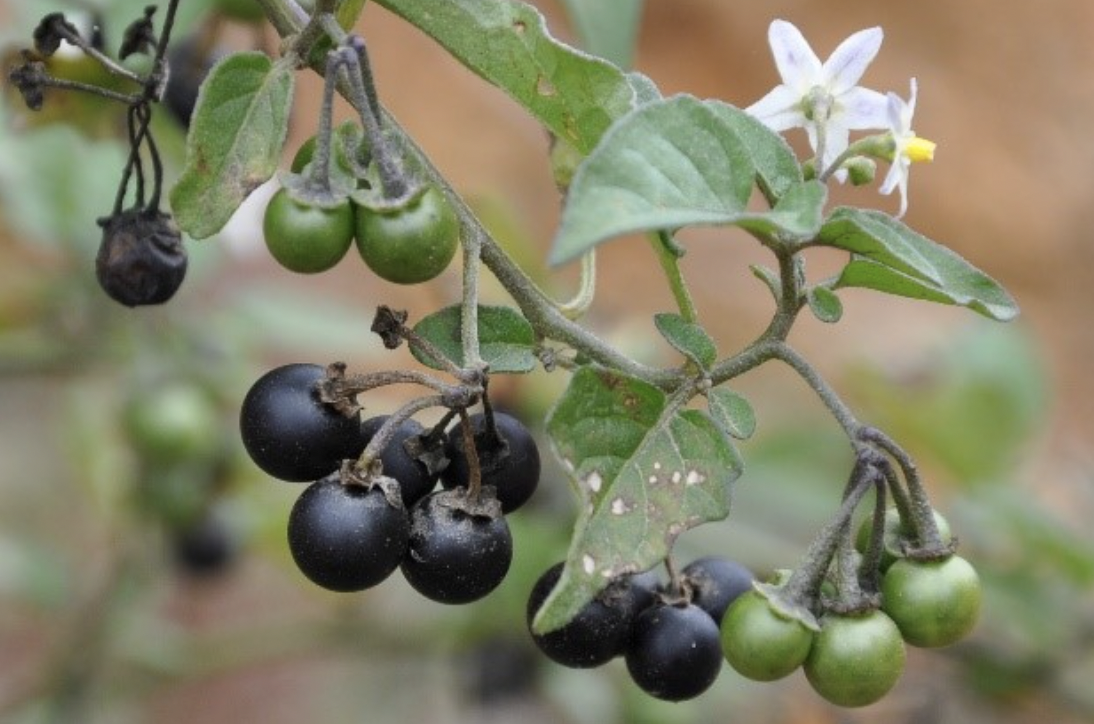
Note the white flowers with yellow anthers
In the words of the inspirational herbalist and farmer Maya Blow, “‘weeds’ are the hardworking immigrants of the plant community”; they show up at sites of disturbance and do the hard work of bringing nutrients and life back into desolate soil. Sure, conservationists and agriculturalists might scorn them because of stories they have around their non-utility and competitive qualities, but they are showing up for a reason. One of the goals of our TIWN series has been to engage in a collective shift of consciousness so that we can see these plants not as invaders, but as newcomers, in need of supportive welcome so that they can find balance in this new landscape, leaving room for natives to thrive.
This framework is also one that our community practices in our work with human newcomers; we run a program to support recently arrived asylum seekers to orient to their new home, receiving them in celebration for their resilience and cultural offerings rather than in the scorn that is characteristic to dominant society’s (and the government’s) orientation towards immigrants.
Far from being “criminals and rapists”, these diasporic indigenous medicine women were peeling the blinding fear back from my eyes so that I could appreciate the distinctions in these plants, and recognize the gifts they carry. Upon further research, I found that there is actually a subtle distinction between “hierba mora” and deadly nightshade; the berries of hierba more grow in bunches, while deadly nightshade bunches grow individually, and the flowers of hierba more are white with yellow anthers while the flowers of deadly nightshade are purple. Subtle distinctions that make a world of a difference! While deadly nightshade can lead to nausea, hallucinations, and even death, hierba mora can guide the body back into balance from digestive and liver problems, gallbladder stones, edema, muscle pain, and insomnia. Tea from the leaves can even be used directly on the skin to treat ulcers, arthritis, and eczema.
I’d been projecting the lethal qualities of belladonna onto ki’s cousin with a blanket condemnation over purple berried nightshades, cutting myself off from receiving the medicine of a generous plant ally because I hadn't been attuned to the subtle differences. Caution and care should still be used around this plant - along with curiosity, and when certain, culinary crafting.
Praise to the wisdom of the plants who volunteer themselves, who don’t wait to be planted by human hands but who burst forth with the willpower to be known, to be seen not for the mess of their misalignment with human intention, but for the melodic message they carry. May their songs lilt us into a dance beyond the strict lines of “weed” and cultivar, of poison and medicine, of good and bad, and into a reality of adaptive cohabitation.